Tuesday, February 11, 2025

Tonks Tuesday on Blanket Mountain

Tonks is a pro at chasing down fresh laundry, especially when it's right out of the dryer and thereby warm. Most often, she follows this mom of hers around when I'm removing blankets from the dryer. Since I can't say no to her, Tonks often gets to enjoy said warm pile of blankets.


Tonks has napped on a great many Blanket Mountains fresh out of the dryer, which is fine, because just look at how cute that little calico is.

Tonks hopes all of you also get to enjoy a nap or two on a warm blanket! Happy Tuesday!


***
Flashback Doodle of the Day

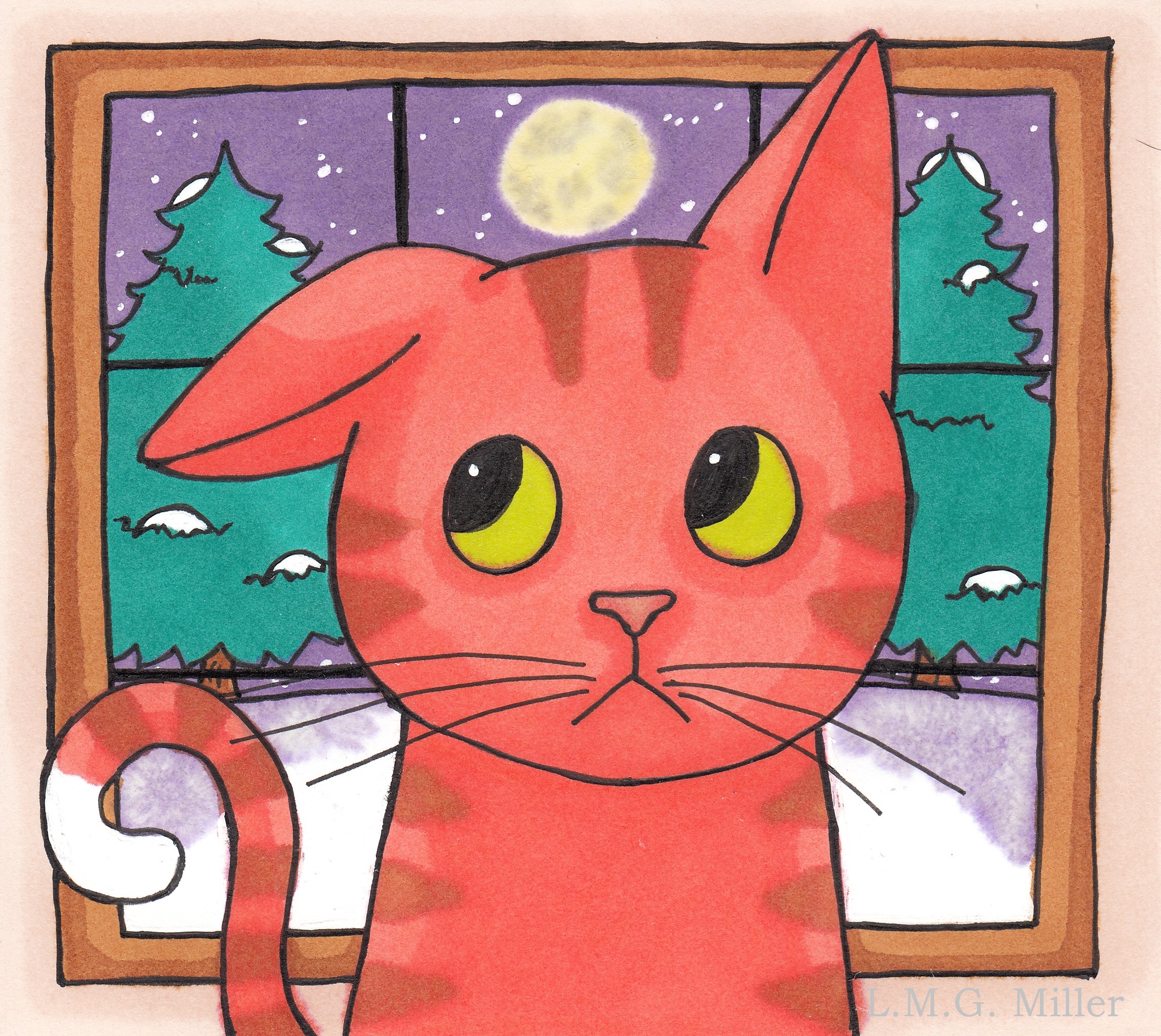
Today, we have for you yet another flashback doodle from the witchy winter series I scribbled up years ago.


***
Tip of the Day

Today's National Cat Health Month tip is one we've mentioned many times, probably even recently, but we'll repeat it yet again because it can be very important for your kitty's health. And this tip is to keep up with those preventatives. Typically recommended for monthly administration, different forms of prevention can, of course, prevent a variety of health concerns. For example, flea prevention can help keep your kitty free from flea infestations, flea bites and related dermatitis, bloodborne diseases that can be contracted from fleas, and other issues that arise from a kitty having fleas. Especially depending on your cat's lifestyle, such as if they go outdoors, administering prevention for parasites such as tapeworms and roundworms can also be significant. If infested, various intestinal worms can lead to issues such as diarrhea and weight loss, among others. Also don't forget the concern of heartworms, which can stem from mosquitoes. Heartworms can be a very dangerous parasite that can affect the heart and lungs, so preventing this is of course something significant to consider. Prevention is something to always consider for keeping your kitty happy and healthy. That being said, do always still discuss this with your veterinarian, who can help you determine your kitty's risk for certain parasites, and which preventatives might be best or safest for your kitty.

Monday, February 10, 2025

Yet Another Mancat Monday with Megacolon

Hello, friends! It's Mancat Monday, and Evan had himself another megacolon sort of weekend.


That photo was actually taken after the poor boy successfully evacuated the stool he'd been struggling to get rid of all weekend. He's resting very well now. And don't mind how Evan is (not) in his bed. Those paralyzed back legs of his don't always make it into the bed with him. If I catch him like that when he's not yet settled, I help him get into his bed better. But, when I find him already snoozing like that there, I let him rest as he is.

Evan and all of us here wish you a magnificent Monday!


***
Flashback Doodle of the Day

It was just over a year ago that Evan's right ear developed a hematoma. It never fully healed, which is why his ear is deformed in photos you see these days, such as the photo above. He struggled with ear infections for the first few months of last year, since the ear deformity blocks airflow into his ear and all that jazz. These days, though, his ear is doing great, all thanks to a specially formulated ear cleaner that a retired vet at our clinic created many years ago. Evan hasn't had an ear infection since I started using that cleaner in his ear last spring.

All the above rambling is to say that I recently rediscovered this doodle I scribbled up after Evan developed his ear hematoma at the end of last January. So, here you go.


***
Tip of the Day

February is not only Spay/Neuter Awareness Month and Pet Dental Health Care Month, but also National Cat Health Month. We've already given tips on the first two, so now we're of course moving on to some tips for keeping those kitties healthy. Our first such tip is to take your cat to the veterinarian for a checkup on an annual basis at the least. In general, a health check is recommended at least every 6 to 12 months. More regular vet visits are of course recommended for any cats with known illnesses, such as kidney disease, hyperthyroidism, diabetes, and cancer, among others.

Visits with the veterinarian do not always just simply mean a quick exam, though. Depending on your furbaby's health, lifestyle, and any other important factors, you will of course have to take into consideration vaccinations, bloodwork, urinalyses, fecal exams, and so forth. Your veterinarian will be able to discuss and offer recommendations on how and when to proceed with these. For example, discuss with your veterinarian your cat's risk for certain illnesses, and discuss any related vaccinations. When it comes to bloodwork and urinalyses, these are often recommended at least yearly for seniors cats, such as those who have reached 6 or 7 years of age. This could allow for early detection of certain diseases. More frequent bloodwork is, of course, recommended for those with known kidney disease, diabetes, and a variety of other diseases.

Of course, also remember to be diligent of your kitty's health in between vet visits. You know your kitty best, and you spend lots of time by his or her side. So, do be sure to do frequent observations and checks of their actions, behaviors, and overall health and happiness. For example, keep an eye on how much your kitty is eating and drinking, and make note of any changes in their food or water intake. In addition, check that litter box and take note of any changes there, such as the amount of urine or feces, or even the odor. Or, has your kitty become less active, or more active? What about the way they walk? Are they walking abnormally, such as favoring a foot? Do they still jump as often and as well as they used to? What about their vocalizations? Is your kitty more vocal than he or she used to be? Less vocal? Has the sound of their voice changed? Is your kitty hiding more often? Has he or she become more aggressive, or less tolerant of being petted or held? These are all just examples of things that you, as your kitty's companion, should keep an eye on regularly. Any such changes, even subtle ones, could be indicative of disease, injury, or any number of issues. So, do be sure to make observations such as these, and report any concerns, no matter how big or how small, to your veterinarian.

Friday, February 7, 2025

Friendly Fill-Ins and Eddy's Gorgeous Eyes

Hello and happy Friday, friends! We're ready for the Friendly Fill-Ins challenge, and we'd love for you to join us. My amazing co-host Ellen of 15andmeowing came up with the first two fill-in statements, and I came up with the second two.


1. My February plans include _________ and _________.

2. I should get rid of ________ because I never use them.

3. _________ is the most useful purchase I've made recently.

4. I would excel in the ________ category on trivia night.


My answers are below in bold. As usual, they're accompanied by lots of rambling that no one is required to read.

1. My February plans include drawing my furry cuties as Harry Potter characters and writing my story starring a kitty in a wheelchair.
(These are perhaps oddly specific answers, but they truly are my February plans for my favorite hobbies. I mentioned recently how I'll be seeing the first Harry Potter film in theaters for the first time as an adult this month, hence why I now must draw all of my kitties and my pup as characters from that world. I'll of course share these doodles with you all. More so, as always, I really want to get into a better habit of writing regularly so as to free all the stories that are stuck in my head. The one involving a lady with a wheelchair-bound kitty is the highest on the list of my story priorities, just because. I know this answer is not only wildly specific but also just kind of weird, but there it is.)

2. I should get rid of my mug collection because I never use them.
(That said, I will not be getting rid of my mugs. I have a couple of mugs that I indeed do use for my drinks. All the others are either sentimental or are ones that I find too cute to risk breaking. Some are even just straight up used as decor. I love mugs. I also have a tendency to break mugs. So, a plethora of unused mugs live at my house.)

3. A pack of giant potty pads is the most useful purchase I've made recently.
(When Evan had one of his recent bouts of diarrhea, which sometimes happens when all of his meds for megacolon-induced constipation kick in a little too hard, I got some humongous potty pads. I had tried potty pads in the past for Evan, but back then I got small ones that his obsessive kneading and digging tore to shreds in half a second. So, this time around I got ones meant for large dogs, to see if they're sturdier. They are. And they saved Evan's blankets and beds, and saved me lots of laundry. I will now be keeping these insanely large potty pads on hand.)

4. I would excel in the furry friends category on trivia night.
(I haven't played any trivia games in a long time. But, back when I played some all those years ago, I would do best with questions relating to animals and biology. That's what I studied in college and that's what I have always had a hefty interest in. I think it was the game Trivial Pursuit that my family used to play, and there was a biology category that I loved. I would include all sorts of questions about animals, including general feline facts, dog breeds, and so on and so forth. I loved that category.)


Now it's your turn!
To add your link to the Friendly Fill-Ins Linky list, just click HERE!
You can also click on the badge below to add your link.


You are also welcome to complete the fill-ins in the comments below,
or in the comments on Ellen's blog, 15andmeowing.


***

Today, your Eddy fix is a flashback I like to share at least once a year. This is because these photos are some of the best I have to show off Eddy's gorgeous eyes, not to mention her adorable snaggletooth.


Eddy has the the most gorgeous aquamarine eyes. Despite how lovely they are in these photos, you really have to see them in person to get the full extent of their beauty. Even so, I love these photos of my sweet and sassy girl Eddy.


Eddy hopes seeing her beauteous face helped make your Friday fantastic!


***
Flashback Doodle of the Day

A few years back I did a witchy winter series of doodles. You saw one of them yesterday, so here's another one today.


***
Tip of the Day

As part of our series of tips for National Pet Dental Health Month, today we'll be discussing some of the symptoms to look out for related to dental disease. First up, of course, is halitosis, or bad breath. This can signify any number of issues, including an infected tooth or gum disease. Of course, bad breath can also come with certain diseases, such as oral cancer or even kidney disease. For these reasons and more, never ignore abnormally rank breath in your cat or dog. Moving on from bad breath, though, if your kitty or pup is suffering from certain dental issues, they may also of course have a decreased appetite, or seem pained or have difficulties when eating. In some dental cases, you also might notice blood or excess drool coming from their mouth. There is also the chance you might visibly notice broken teeth, loose teeth, discolored teeth, or even tartar buildup. Also don't forget that the teeth are in close proximity to and therefore often linked to the eyes and nasal cavity, and so discharge from either of these can also potentially signify an oral concern. All in all, if you smell, see, or in any way notice concerns relating to your furbaby's mouth, or any part of their body, do be sure to have them examined by a veterinarian. Dental health can even be linked to heart health and other systems of the body, so this is again one of those cases in which it is always better to be safe than sorry.

Thursday, February 6, 2025

Thankful Thimble Thursday: The Late Night Edition

It's Thursday, which of course means Thimble is here and more than ready for Angel Brian's Thankful Thursday Blog Hop.


Today, Thimble is grateful for bedtime cuddles. Thimble is the kitty who pretty much always wins the bedtime game of king of the hill, meaning she gets to sleep on me. She's also the kitty who likes to poke and prod me in the face to wake me up for cuddles periodically throughout the night, at which point I find this cute face looking at me.


Just look at that adorableness. I can't even be mad when Thimble wakes me up for cuddles. She's just too cute, and so the cuddles happen whenever she asks for them, day or night. That particular photo above was snapped at roughly 2 am, I believe. Again, though, Thimble is so cute that she gets away with it.


***

Now, let's share the fill-in statements for tomorrow's Friendly Fill-Ins challenge. My amazing co-host Ellen of 15andmeowing came up with the first two, and I came up with the second two.

1. My February plans include _________ and _________.

2. I should get rid of ________ because I never use them.

3. _________ is the most useful purchase I've made recently.

4. I would excel in the ________ category on trivia night.


We'll see you tomorrow, friends!


***
Flashback Doodle of the Day

I had nearly forgotten about this old doodle of a witch reading away, surrounded by her feline friends on a winter day. So, since I discovered it again, here it is.


I promise I do have some new doodles coming up soon. I actually have a few finished, I just haven't gotten my scanner up and running lately in order to get my doodles uploaded. Either way, new doodles coming your way soon.


***
Tip of the Day

Among other things, February is National Pet Dental Health Care Month. So, of course we'll be giving a couple of tips on keeping those pearly whites healthy and happy. Let's start with a quick discussion on at-home care and dental disease prevention. First and foremost, of course, is the act of brushing your furbaby's teeth, which can help remove food morsels, plaque, and other debris that could lead to tartar and other dental issues. Though this is not a job that every furbaby enjoys or even allows, if they are trained to accept it and it is done correctly, brushing can help keep those teeth healthy and happy. There are pet-friendly toothpastes and other oral cleansers out there, as well as pet-friendly toothbrushes and other similar tools for cleaning those teeth. There are even products on the market that more heavily focus on helping treat gum disease, such as for those furbabies with a history of gingivitis or stomatitis. Not all dental products are created equally, though, so if you are unsure what is safest or best for your furbaby, then most certainly discuss the options with your veterinarian.

There are also other types of products on the market that can potentially help teeth remain as healthy as possible. These of course include treats and food formulated for dental health. This is something that again can be discussed with your veterinarian, as he or she will best be able to guide you to products that are the most reliable and effective.

Dental care can of course start at home, but do keep in mind that it is still possible for tartar, gingivitis or stomatitis, and other forms of dental disease to arise even with brushing and other at-home care being used. Tomorrow we'll discuss some of the symptoms you might notice if your furbaby's oral health is in need of further assistance.

Wednesday, February 5, 2025

Wintry Adventures with Astrid

After a couple of warmer days, we're getting some more wintry weather around here. And winter-loving pup Astrid is perfectly fine with that.


Warm wishes to all!


***
Flashback Doodle of the Day


***
Tip of the Day

Our last tip related to Spay/Neuter Awareness Month is to make sure that you know and follow the proper pre-op preparation and post-op treatment for your furbaby's operation. Just as with any anesthetic event, there are some rules that will need to be heeded for your furbaby's health and safety. To begin, a cat or dog's food should be withheld well in advance to going under anesthesia. Ask your veterinarian how early to pull your kitty or pup's food, as their age can affect this. For example, adults may need their access to food cut off at 10 pm or thereabouts the night before surgery, whereas young kittens or puppies may need to be allowed access to food until the early hours of the morning of their surgery. Of course, also ask your veterinarian if there are other requirements prior to surgery.

The at-home care will continue after the surgery as well, of course, so also be sure that you follow these instructions from your veterinarian. For example, make sure you know how much and how often to give any medications that are sent home with your furbaby after surgery, which may include pain medication or antibiotics. It is also of course important to keep spayed or neutered furbabies calm and as least active as possible, so that they can recover safely and quickly. This is especially important for females, so that their abdominal sutures remain intact and their incision heals properly. If necessary, a kitten or pup can be secluded to a safe area of the house, where they can recover and heal as needed. Spaying and neutering is incredibly important, but so is the care required before and after the surgery itself.

Tuesday, February 4, 2025

Toothless Tonks Tuesday

Today, Tonks wanted to share a shot from the same photo shoot as her post from last week. This time, though, she wanted to show off her teeth. Or, her lack thereof.


As you can see, Tonks does indeed have some teeth. But, did you count her canine teeth in that photo? She has but one. Both Tonks and Thimble underwent dentals back in October. While Thimble lost the most teeth that day and now has a bottom jaw with essentially no teeth, Tonks lost three of her four canines. Her upper right canine was the only one to survive the dental procedure.

Tonks hopes seeing her adorable, partially toothless self helped brighten your day!


***
Flashback Doodle of the Day

We've been experiencing some rain and wet snow these days. The umbrella has indeed made more than one appearance lately, and so this doodle seemed apt enough for today.


***
Tip of the Day

For today's Spay/Neuter Awareness Month tip, we're discussing how it is important to be aware of your cat or dog's age and size, and to have them spayed or neutered at an appropriate, safe, effective time of their kittenhood or puppyhood. This is important, for one, because cats can potentially become pregnant as early as 4 or so months of age. Dogs fall not far behind that, with the potential for becoming pregnant at 5 or so months old. Should your kitten or puppy get loose, this means they could come back pregnant even at such a young age.

In addition, spaying or neutering your furbaby before they go through their first estrus or pregnancy will give them the best chance of remaining free from related health issues later in life, such as mammary cancer. Spaying or neutering before their first cycle can also help to potentially reduce the display of certain behaviors, such as spraying. Though certain such health or behavioral issues can still arise even if a furbaby is spayed or neutered, having this surgery performed before their first cycle can reduce the risk.

So, then, when should you have your cat or dog spayed or neutered? The short answer is to discuss this with your veterinarian. Ultimately, it depends on the individual animal's overall health and development. For typical, healthy kittens and puppies, the AVMA has endorsed spaying and neutering as early as two month of age, and/or when the kitten or puppy has reached two pounds. Many shelters and rescues follow this practice. Some veterinarians will prefer to wait a little longer, such as when the kitten or puppy has reached three, four, or even five months of age. Essentially, a veterinarian will best be able to determine when is the best time for your furbaby to be safely and effectively spayed or neutered, so of course discuss this with a professional.

Monday, February 3, 2025

Mancat Monday: Evan vs. Medicine

It's Mancat Monday, and today orange boy Evan wanted you all to see the abuse that is him getting his many medications.
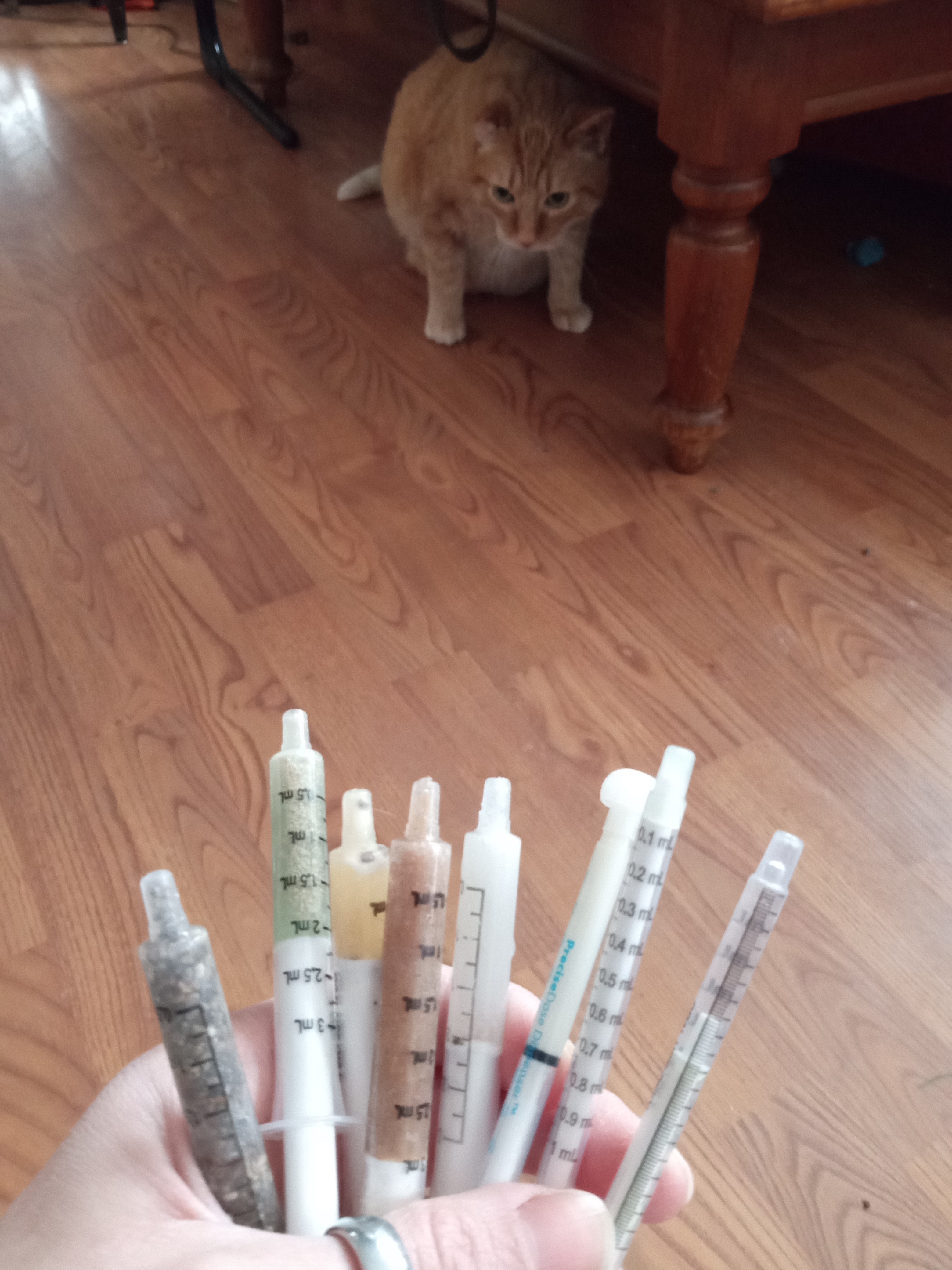
Evan is on various medications for his urinary issues, megacolon/intestinal issues, anxiety, various sources of pain and discomfort, and so on and so forth. He gets gabapentin, prazosin, meloxicam, cisapride, Miralax, Metamucil, probiotics, amitriptyline, and even chia seeds (initially prescribed for hypercalcemia but which has also started serving as a fiber source for his colon), as well as a specialized cleaner for his poor messed up little right ear. Evan gets all 10 of those medications most mornings, and at least half of them in the evening as well. He refuses to take any of his oral medications in food or treats, so they all have to be syringed to him in one way or another. The poor boy does not like medication time, but he's a very good boy and lets me give him all of them nonetheless.

And don't worry, because Evan gets lots of cuddles before, during, and after medication time. And he also gets treats after taking his meds, which he always remembers and immediately asks for when we're done. I like knowing that he has his favorite treats to look forward to after being such a good boy and letting me give him that many meds.

Happy Monday, friends!


***
Flashback Doodle of the Day


***
Tip of the Day

February is a busy month. At least, in terms of important messages it is. February is Spay/Neuter Awareness Month, National Pet Dental Health Month, and National Cat Health Month. Over the past couple of years, we've filled February with tips on all of these topics. We've decided to do the same again this year, since the topics at hand are significant ones. So, we'll be repeating and revamping our February tips from previous years. Brace yourself for a month all about health and wellness.

We'll start with spaying and neutering. As you all surely know, spaying and neutering your pets, as well as ferals outdoors, helps significantly reduce cat and dog overpopulation. This in turn reduces the number of homeless animals, the number of furbabies awaiting homes in shelters, and the number who are, sadly, euthanized due to lack of space in the shelter system. That being said, if possible, don't just stop at getting your kitty or pup spayed or neutered. If possible, consider assisting in or donating to trap-neuter-release (TNR) efforts, so that even those kitties who are most comfortable with an outdoor life can enjoy a life that does not involve contributing to pet overpopulation. All of us here certainly love animals, but all of us also certainly feel heartbroken when we remember that there are a great many cats and dogs without homes due to uncontrolled reproduction and overpopulation. So, have your pets spayed and neutered, and, if possible, do what you can to help in the efforts to have feral colonies spayed and neutered as well.

Today we'll also mention how an individual kitty or pup's health can benefit from being spayed or neutered. Just to give a couple of examples, spaying a female cat or dog can eliminate the risk of uterine cancer or infection, and can reduce the risk of mammary cancer. For male cats and dogs, neutering can eliminate the concern of testicular cancer and can reduce the risk of diseases of the prostate. Of course, pregnancy itself can be risky, so a spayed cat or dog is also free of unexpected pregnancy and the dangers that come with it. In addition, spaying and neutering can reduce certain troubling behaviors. For example, spaying and neutering can reduce attempted escapes by animals in search of a hot date, as well as reduce spraying, yowling, and other such hormonally-induced behaviors. All in all, spaying and neutering your animals can indeed provide many benefits for the health, safety, and happiness of your kitty or pup.